
GMDS – Global Moral & Damage System
Prevent injustice. Repair harm. Protect people
A worldwide, AI-assisted system guided by a universal moral code. It aims to prevent the gravest crimes, assess harm, support redress, and help secure basic necessities for all.
Forum discussions may be in German. Use your browser’s page translation to read them in English. In Chrome, right-click the page and choose “Translate to English”.
What does GMDS aim to do?
With the help of artificial intelligence, a central problem of human coexistence could be addressed: crimes without consequences. When an offence or crime goes unpunished, the lack of justice can hinder rehabilitation and deny victims redress.
Many crimes, wars, crises and injustices around the world are driven in part by financial motives. If wrongdoing carried direct financial consequences, some financial incentives could be reduced. Destroying a house would be less worthwhile if the damage had to be paid for later.
Turning this idea into practice would require three elements: a universal morality, a comprehensive value framework for plants, animals, ecosystems, people and human creations, and a body responsible for enforcing financial measures and reducing severe hardship.
Given current developments, artificial intelligence could influence or control large parts of human communication and the financial sector within a few years. The possibility that a “superintelligence” could take final control away from humanity is a growing concern in science and politics. The decisive question is who could control such capabilities and whether they would improve human coexistence or plunge it into chaos. GMDS wants to encourage public discussion. There is still time. Once AI and its capabilities fall into the wrong hands, however, it may be too late for discussion.
GMDS serves to protect humanity and the foundations of life. It detects and investigates the gravest crimes, promotes their prevention, ensures redress governed by the rule of law, secures a dignified basic standard of living for all in the long term, and subjects itself to independent, transparent oversight.
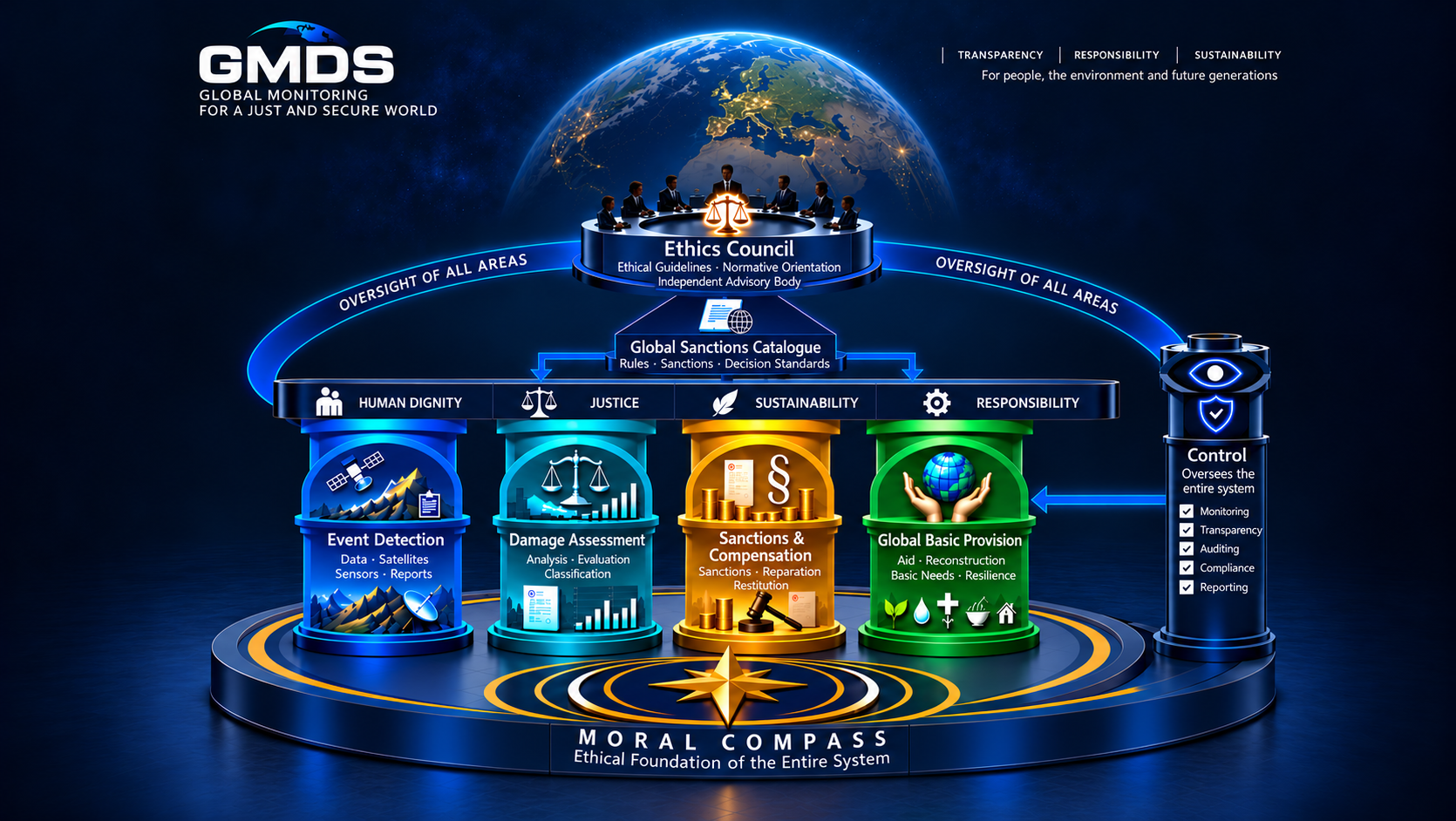
The principles of GMDS
- A future system could detect certain forms of injustice, identify possible perpetrators, document the resulting harm, and initiate compensation through regulated financial systems.
- The Moral Index underlying this mechanism would be defined by people. It could provide a shared point of reference across national laws, state sovereignty and individual rights.
- A future AI system could record destructive actions, identify possible perpetrators, assess responsibility and document resulting harm, and initiate compensation.
- If a state committed wrongdoing, responsible decision-makers and culpable collaborators could first be held financially liable, followed by the state itself.
- Existing legal systems, shaped by different religious, moral and ethical traditions or by arbitrary decisions, could be supplemented or replaced by a universal sanctions framework designed to be more effective and more deterrent than current legal systems.
- A worldwide, independent system for meeting basic needs would be both possible and necessary. Advances in robotics and AI are enabling more output with less human labour, but may also widen economic inequality and deepen social divisions. The long-term goal must be to guarantee every person a dignified minimum standard of living, regardless of origin, nationality, wealth or political circumstances.

World Moral Council
100 members plannedAn international body for human oversight is planned. Its selection process and responsibilities will be discussed publicly.

Public participation
Discuss rules, review case assessments, submit improvements and shape the system together.
The GMDS system
The five pillars of GMDS

Event Capture
Early detection of the gravest crimes and serious harm worldwide. With the help of AI, suitable information sources are systematically evaluated, including satellite imagery, publicly available information, reports from aid organisations and reports from the public.


Damage Assessment
Investigation of identified events and the parties responsible. Calculation of appropriate financial sanctions and claims for redress using the Moral Compass and Global Sanctions Catalogue.


Sanctioning
Enforcement of sanctions and compensation. Ensuring that people, communities and the environment are compensated or restored as far as possible through automated payment processing in an internationally regulated financial system.
Basic provision
Dignified living conditions and long-term access to food, water, housing, education and healthcare.
Control Centre
An oversight body that is institutionally and financially independent, monitoring the entire GMDS organisation, especially its AI systems, decision-making procedures, financial powers and compliance with ethical and legal principles.
 5PillarsFrom principles to accountable action
 100planned council membersHuman oversight · designed internationally
 Shape it publiclyOpen participation. A shared future.
A project in development. Discuss together, document carefully, improve transparently. View project status