Food
A secure minimum supply of sufficient calories, nutrients and suitable food, prioritising local agriculture, supply chains and supplementary food assistance.

This pillar expands GMDS’s tasks beyond investigating and compensating culpably caused harm by deliberately using GMDS event reporting and oversight of the financial system to secure a worldwide minimum entitlement to food, drinking water, medical care, housing and other essential foundations of life.
The distinction is essential: basic provision is a universal entitlement, but it is not a blanket cash payment to everyone. Support is provided to people whose minimum provision is not otherwise secured.
I would define six areas of provision, but not turn them into additional organisational GMDS pillars.
A secure minimum supply of sufficient calories, nutrients and suitable food, prioritising local agriculture, supply chains and supplementary food assistance.

Drinking water, sanitation, wastewater management and basic hygiene. Durable water infrastructure matters more than regular water deliveries.

Basic medical care, vaccinations, maternity care, essential medicines and emergency treatment, including necessary transport.
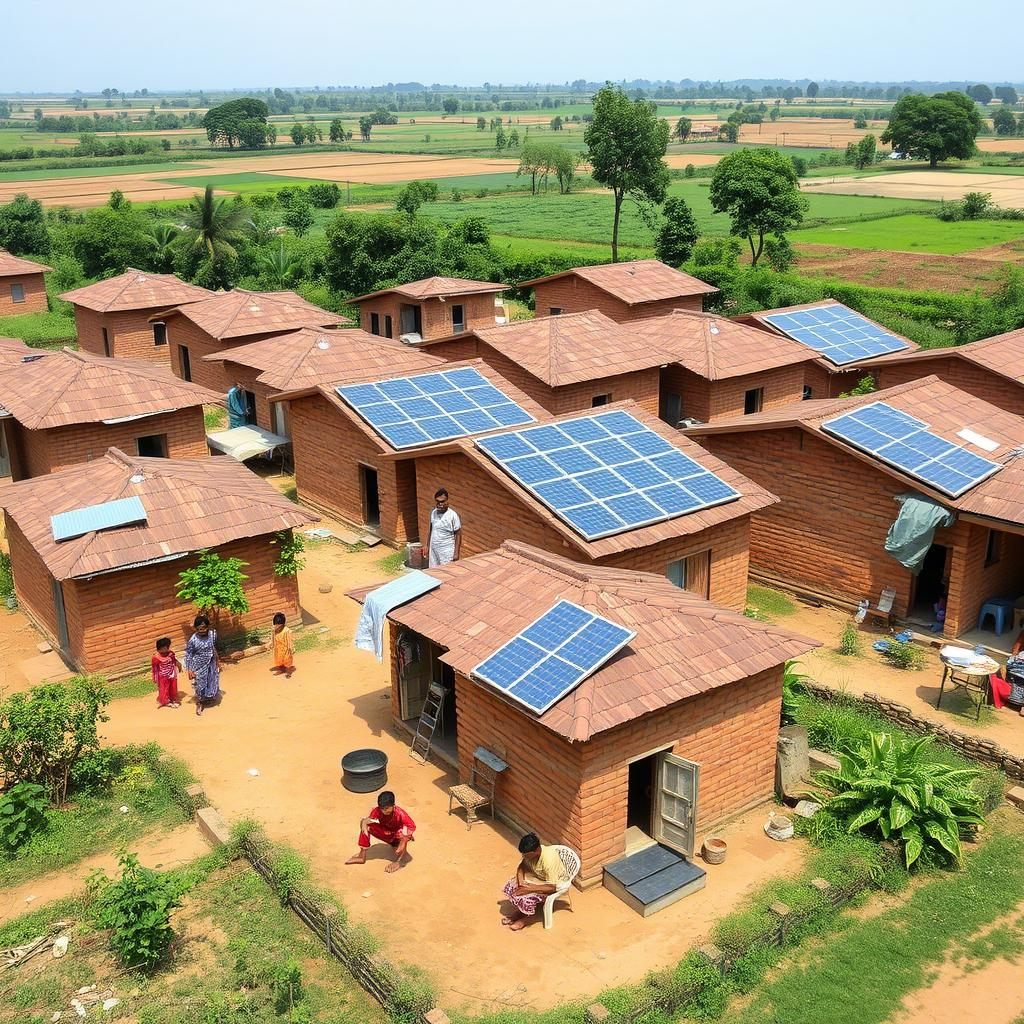
Protection from the elements, dignified housing and essential equipment. In wars and disasters, emergency shelters come first, followed by durable solutions.

Access to basic education, literacy and essential digital skills, helping people become independent of support in the long term.

Electricity for lighting, cooling medicines, water pumps, communication and other indispensable purposes.
GMDS · Concept view
Colour countries by available indicators of provision gaps. Choose an area and region, then select a country.
Colours use national indicators from 2018 onwards with different reporting years. Health shows only DTP vaccination, education adult literacy, and housing the urban population living in slums. These proxies do not cover all services or differences within countries. Grey means missing or older data.
Country values come from World Bank indicators. A later expansion could incorporate WHO, UNICEF, FAO and ILO data, regional figures and documented aid programmes.
If robotics and artificial intelligence could replace nearly all human paid work, it would probably be one of the most profound changes in human history.
We would have to fundamentally rethink our current economic and social system. For the first time, a situation could arise in which people no longer have to work to produce nearly all the goods and services they need.
This could lead either to historically unprecedented prosperity or to an extreme concentration of wealth and power.

These studies cover different technologies, countries and scenarios. Technical potential is not a prediction of actual job losses.
| Period | Institution | Projection |
|---|---|---|
| Mid-2030s | PwC (2018) ↗ | Across 29 countries studied, an average of about 30% of jobs could face a high technical risk of automation. |
| 2035 | McKinsey (2026) ↗ | In the US, automation could reduce labour demand by the equivalent of about 36 million full-time jobs, while other developments could create roughly 41 million jobs. |
| 2045 | McKinsey (2023) ↗ | In the midpoint scenario, half of today’s work activities could be automated; the modelled range spans 2030 to 2060. |
| 2050 | Morgan Stanley (2025) ↗ | A speculative market forecast envisages more than one billion humanoid robots, about 90% in industrial and commercial use. |
Standardised tasks in manufacturing, warehousing, packaging and perhaps later transport may disappear. New jobs will not necessarily go to the same people.
Automating tasks could weaken bargaining power in some occupations. The OECD describes this as a possible risk, not an established general wage effect. Source ↗
Productivity gains may flow disproportionately to owners of robots, software and firms. The IMF warns that higher returns to capital could widen wealth inequality. Source ↗
People whose skills lose value, regions dependent on one industry, and countries competing on low labour costs may face particular pressure to adapt.
Fewer human work hours could weaken wage-based contributions. Without income support, purchasing power may lag behind rising output.
Digital monitoring and machine-paced work can reduce autonomy while increasing work intensity and stress. Source ↗
Robots and AI can take over tedious or dangerous tasks and reduce burdens on workers. Source ↗
Automation can enable more goods and services with less labour. Who benefits from the gains also depends on policy choices. Source ↗
Robots can supplement scarce workers in specific manufacturing and logistics tasks. Source ↗
If productivity gains are shared fairly, more resources could become available for essential services and social protection. Source ↗
| Area of work | Possible development |
|---|---|
| Industrial assembly, welding, packaging | Already highly amenable to automation |
| Warehousing and goods handling | Increasing automation |
| Transport and delivery | Considerable long-term potential, with technical and legal hurdles |
| Cleaning and simple services | Partial automation increasingly possible |
| Care and medicine | Primarily support rather than full replacement |
| Craft work in changing environments | Much harder to automate for now |
Today’s specialised industrial robots differ from general-purpose humanoid robots. Many humanoids are still in pilot applications; dexterity, safety, reliability and costs limit deployment. IFR ↗
AI also affects work without robotics: according to the ILO, about one in four jobs worldwide could be exposed to generative AI. Most jobs are more likely to change than disappear altogether. ILO ↗
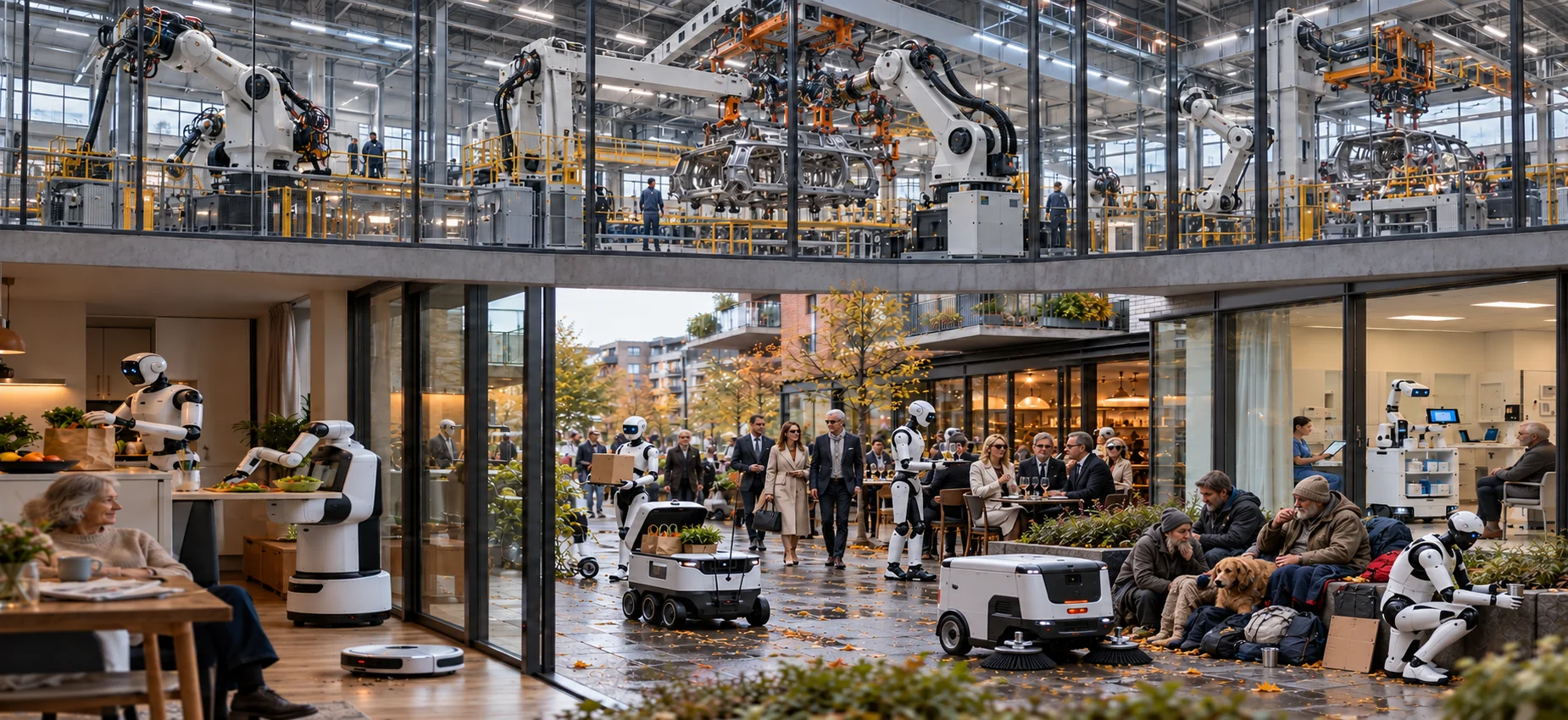
How can people’s livelihoods be secured if human labour is needed less and less?
Today, livelihoods are financed primarily through wages, returns on capital or public transfers. In a highly automated society, a growing share of output could be produced with fewer human work hours.
If human labour’s share of value creation declines in the long term, basic social security would need to depend less exclusively on wages. The basic provision envisaged by GMDS could become more important.
Basic provision already matters today: there are major gaps in social protection worldwide. Robotics and AI could add urgency if wages and returns on capital diverge further.
ILO estimates for 2023: ILO ↗ · Annual financing gap ↗
The US$1.4 trillion covers essential health care and five social protection benefits in low- and middle-income countries. It is not a full cost estimate for GMDS.
A worldwide minimum level of social protection is already an immense task. The challenge is to share the opportunities of automation while cushioning its social risks.
Even if basic material needs were met, other fundamental risks would arise: