
Back to homepage

Global violence and damage statistics

Global statistics on violence and the resulting economic and human damage reveal a divided picture: while crime and homicide rates in many major economies decline over the long term, state conflicts and targeted violence against civilians have reached historically high levels.

It is clear that sanctioning crimes can be worthwhile. If only half of an annual damage total of 25 trillion (a relatively low estimate of annual damage) were recovered, that amount could theoretically provide everyone on the planet living in extreme poverty with a monthly income of more than €1,200.

Illustrative calculation with adjustable assumptions. The displayed amounts are neither measured worldwide damage nor guaranteed GMDS payments. PPP reference thresholds and euro amounts use different units.

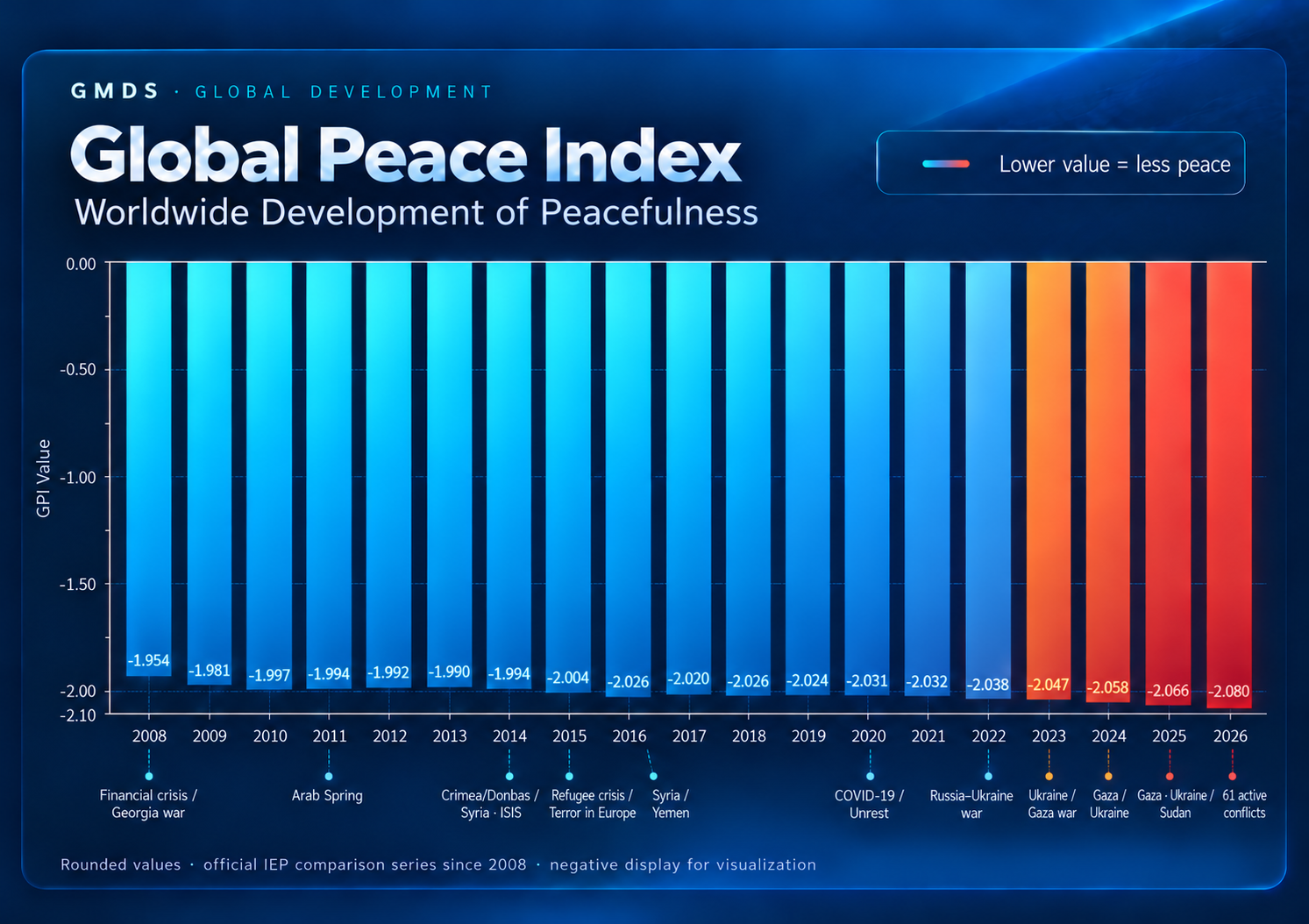
Global Peace Index 2026

Key results

Source: Institute for Economics & Peace, press release, 9 June 2026 (PDF)

Chart of Global Peace Index values from 2008 to 2026; lower values indicate less peacefulness.

Global perspective

Interactive conflict atlas 2026

34 selected war and conflict complexes and situations of organised violence in the editorial snapshot of 21 October 2026.

1. Economic impact of violence

The Global Peace Index 2026 puts the global economic impact of violence in 2025 at US$21.81 trillion in purchasing power parity terms (US$2.81 trillion is approximately €2.51 trillion, more precisely: €2,508,402,700,000). According to IEP, this is 10.5% of global gross domestic product. The model includes military spending, internal security costs and economic losses, among other things. It is therefore not solely an account of destroyed physical assets or individually attributable damage.

  • According to IEP, global military expenditure in 2025 reached approximately US$2.9 trillion.
  • The total describes modelled economic effects; it is not equivalent to compensation actually paid.

2. Wars and armed conflicts

The Global Peace Index 2026 counts 61 active state-based conflicts in 2025 – the highest level since the end of the Second World War. The country-based analysis of the Uppsala Conflict Data Program (UCDP), Country-Year dataset version 26.1, gives a 2025 best estimate of 245,464 deaths from organised violence: 153,782 linked to state-based conflicts, 14,936 in non-state conflicts and 76,746 from one-sided violence. The source range is 170,801 to 351,950. Data versions, geographical attribution and recording methods may differ from other conflict statistics. IEP / Global Peace Index · UCDP original data and codebook

Displacement figures show further consequences: at the end of 2025 there were 41.6 million refugees worldwide and 68.7 million internally displaced peoplewho had fled conflict or violence within their country. These stock figures are not equivalent to the number newly displaced during a year. UNHCR Global Trends 2025

3. Homicide and cybercrime

The UN SDG Report 2026 reports a global intentional homicide rate for 2024 of 5.1 per 100,000 people. With approximately 8.2 billion people, GMDS projects approx. 420,000 homicide victims in 2024. This is not an exact UNODC total: the rate and population are rounded. Sources and calculations appear in the statistics section below. The rate alone does not show regional differences.

According to a UNODC analysis, cybercrime has no complete global estimate of its scale. Reports and surveys cover different offences and population groups. No single global victim or damage figure is therefore presented here as confirmed statistics. UNODC: The Nexus Between Cybercrime and Corruption

4. Lethal violence against women and girls

For 2024, UNODC and UN Women estimate that 83,000 women and girls were intentionally killed worldwide . Approximately 50,000 were killed by their partner or another family member – an average of about 137 per day. The estimate for 2023 was 51,100 such killings; changes between years may also reflect differences in data availability. UNODC / UN Women: Femicides in 2024

5. Terrorism

The Global Terrorism Index 2026 reports that global terrorism deaths in 2025 fell by 28% to 5,582. Pakistan was the most affected country for the first time; six of the ten most affected countries were in sub-Saharan Africa. A global decline therefore does not mean that the burden has decreased in every region.

Global figures · Estimates and projections

Wars, homicides and other crimes

Missing offence counts are supplemented by a disclosed GMDS model. Recorded events, source estimates and our own projections are shown separately. Data retrieved: 21 October 2026. Not a live counter.

Lethal violence

UCDP best estimate · 2025

Wars and organised violence

245,464

Deaths in the country-based analysis

UCDP source range · 2025

Separate scale in thousands of deaths

  • Lower to upper estimate
  • Best estimate
Lower estimate
170,801
Best estimate
245,464
Upper estimate
351,950

The range shows uncertainty in UCDP recording, not statistical confidence limits. Indirect deaths, for example from hunger or destroyed services, are not fully recorded.

Source range: 170,801–351,950. Sum of the 196 country/territory rows of the Country-Year dataset, version 26.1. Not statistical confidence limits.

UCDP original data (CSV ZIP) ↗ · Codebook ↗

Composition and source

State-based conflicts: 153,782; non-state conflicts: 14,936; one-sided violence against civilians: 76,746. Sum of the three categories, not the subcategories.

Best, low and high estimates are each summed across geographical units. Indirect deaths, for example from hunger or destroyed services, are not fully recorded.

GMDS projection · 2024

Murders / intentional homicides

approx. 420,000

Homicide victims per year, derived from a global rate

UN global rate 2024: 5.1 per 100,000 people × approximately 8.2 billion people. Rounded inputs mean this is not an exact UNODC victim total.

GMDS rounding range · 2024 · calculation precision only

Separate scale in thousands of homicide victims

  • Rounding range only
  • Central calculated value
Lower rounding limit
approx. 412,000
Central calculated value
approx. 418,000
Upper rounding limit
approx. 425,000

Derivation: GMDS assumes rounding to the displayed precision – rate 5.05 to below 5.15 per 100,000 and population 8.15 to below 8.25 billion. Rate × population ÷ 100,000 gives approx. 412,000–425,000.

Rounding only, not a complete uncertainty range. Not an estimation interval published by UNODC and not confidence limits. Missing reports, undetected killings, misclassification and estimation errors are not quantified; actual victim numbers may lie outside it. The reviewed UN reports provide no global numerical range for 2024.

UN SDG 2026: 2024 rate ↗ · UN world population 2024 ↗ · UN: data gaps, p. 3 ↗ · UNODC/WHO: methodology ↗ · UNODC homicide data ↗

Calculation and sources

5,1 ÷ 100.000 × 8.200.000.000 = 418,200 before rounding. No extrapolation to 2026 or evidence of a current trend.

Lower-limit calculation: 5.05 × 8,150,000,000 ÷ 100.000 = 411,575. Upper-limit calculation (excluded endpoint): 5.15 × 8,250,000,000 ÷ 100.000 = 424,875. The chart uses these unrounded calculated values; labels are rounded to thousands. The headline figure of approx. 420,000 is rounded more coarsely than the central calculated value of approx. 418,000.

The rounding assumption comes from GMDS, not UNODC. The UNODC/WHO methodology already describes filling missing country/year values for global totals, so no additional blanket underreporting factor is applied. The UN supplementary report 2026 highlights uncertain estimates for sub-Saharan Africa due to limited data availability, but gives no global range.

Supplemented offence counts: model for police-recorded crime

GMDS model · Reference year 2024

Rape

approx. 1,300,000

Cases per year in the global recorded-crime model

Assumption range: approx. 780,000–2,300,000. Not confidence limits; no adjustment for unreported crime.

Basis: 70 countries/territories · 22.7 % of the world population

Calculation and data basis

UNODC, ICCS 03011: 288,657 reported cases among 1,860,538,614 people. Pooled rate: 288,657 ÷ 1,860,538,614 × 100.000 ≈ 15.51 per 100,000.

Central model: reported cases + rate × missing population ÷ 100,000. This corresponds to the same rate for a total of 8.2 billion people.

Lower/upper assumption: half/twice the registered rate is applied to the uncovered population. Reported cases remain unchanged. These factors are GMDS assumptions, not estimation limits published by UNODC.

UNODC original table (Excel) ↗ · Definitions and limitations ↗

GMDS model · Reference year 2024

Robbery

approx. 10,000,000

Cases per year in the global recorded-crime model

Assumption range: approx. 6,200,000–18,000,000. Not confidence limits; no adjustment for unreported crime.

Basis: 73 countries/territories · 22.6 % of the world population

Calculation and data basis

UNODC, ICCS 0401: 2,278,184 reported cases among 1,855,714,607 people. Pooled rate: 2,278,184 ÷ 1,855,714,607 × 100.000 ≈ 122.77 per 100,000.

Central model: reported cases + rate × missing population ÷ 100,000. This corresponds to the same rate for a total of 8.2 billion people.

Lower/upper assumption: half/twice the registered rate is applied to the uncovered population. Reported cases remain unchanged. These factors are GMDS assumptions, not estimation limits published by UNODC.

UNODC original table (Excel) ↗ · Definitions and limitations ↗

GMDS model · Reference year 2024

Kidnapping

approx. 260,000

Cases per year in the global recorded-crime model

Assumption range: approx. 160,000–460,000. Not confidence limits; no adjustment for unreported crime.

Basis: 70 countries/territories · 23.8 % of the world population

Calculation and data basis

UNODC, ICCS 020221: 62,641 reported cases among 1,953,472,218 people. Pooled rate: 62,641 ÷ 1,953,472,218 × 100.000 ≈ 3.21 per 100,000.

Central model: reported cases + rate × missing population ÷ 100,000. This corresponds to the same rate for a total of 8.2 billion people.

Lower/upper assumption: half/twice the registered rate is applied to the uncovered population. Reported cases remain unchanged. These factors are GMDS assumptions, not estimation limits published by UNODC.

UNODC original table (Excel) ↗ · Definitions and limitations ↗

GMDS model · Reference year 2024

Other crimes: serious assault

approx. 7,200,000

Cases per year in the global recorded-crime model

Assumption range: approx. 4,500,000–13,000,000. Not confidence limits; no adjustment for unreported crime.

Basis: 75 countries/territories · 24.9 % of the world population

Calculation and data basis

UNODC, ICCS 020111: 1,782,864 reported cases among 2,042,844,759 people. Pooled rate: 1,782,864 ÷ 2,042,844,759 × 100.000 ≈ 87.27 per 100,000.

Central model: reported cases + rate × missing population ÷ 100,000. This corresponds to the same rate for a total of 8.2 billion people.

Lower/upper assumption: half/twice the registered rate is applied to the uncovered population. Reported cases remain unchanged. These factors are GMDS assumptions, not estimation limits published by UNODC.

UNODC original table (Excel) ↗ · Definitions and limitations ↗

Unreported crime: what might additionally remain unrecorded?

The basis is the UNODC recorded-crime model for 2024 above. Different low, central and high reporting rates are assumed for each offence. All following quantities are modelled cases per year, not counts of distinct affected people.

Recorded and unreported crime compared

Bars show the central hypothetical scenarios, not measured global figures. Gold ranges below mark the combined lower and upper limits; the diamond shows the central scenario. Bars and ranges use the same absolute scale covering every upper limit. Not confidence limits. Figures, sources and full assumptions remain visible below the bars and in detail cards.

  • Recorded-crime model
  • Additional unreported crime (model)
  • Combined scenario range (not confidence limits)
  • Central scenario

Shared scale: 0–75 million cases per year

Rape
Total approx. 13,000,000

Recorded approx. 1,300,000+ unreported approx. 11,000,000

Central scenario: assumed reporting rate 10 %; tested 5 %–25 %.

Combined scenario range: approx. 3,100,000–45,000,000 cases in total. Not confidence limits.

Robbery
Total approx. 20,000,000

Recorded approx. 10,000,000+ unreported approx. 10,000,000

Central scenario: assumed reporting rate 50 %; tested 25 %–75 %.

Combined scenario range: approx. 8,200,000–71,000,000 cases in total. Not confidence limits.

Serious assault
Total approx. 14,000,000

Recorded approx. 7,200,000+ unreported approx. 7,200,000

Central scenario: assumed reporting rate 50 %; tested 30 %–75 %.

Combined scenario range: approx. 6,000,000–42,000,000 cases in total. Not confidence limits.

GMDS unreported-crime scenario · Base year 2024

Rape

approx. 13,000,000

Recorded and unreported crime combined, central scenario

Recorded-crime model
approx. 1,300,000
Additional unreported crime
approx. 11,000,000
Assumed reporting rate
10 %

Combined scenario range
approx. 3,100,000–45,000,000 in total

Combines the recorded-crime range above with 5 %–25 % reporting rate. Not confidence limits or a statistically established global range.

Assumptions, sources and calculation

5–25%: deliberately broad test range around national reference values. 10% is a chosen calculation assumption, neither a global average nor the average of the studies.

BKA SKiD 2024, report p. 48 ↗: 6.2% for rape and coerced sexual acts. Germany, 2024 survey about experiences in 2023.

US BJS / NCVS 2024, Table 4, p. 7 ↗: 23.6% for rape or sexual assault. Survey year 2024 with retrospective interviews.

Both survey categories are broader than UNODC's rape category (ICCS 03011). They do not establish a directly transferable rate for this specific offence.

Central scenario: H ÷ q = 1,272,205 ÷ 10 % ≈ 12,722,055 in total. Additional unreported crime = total − H ≈ 11,449,849.

Combined range: H low ÷ q high = 780,431 ÷ 25 % ≈ 3,121,725; H high ÷ q low = 2,255,754 ÷ 5 % ≈ 45,115,079.

If only the reporting rate varies and H remains at the central recorded-crime model: approx. 5,100,000–25,000,000 in total. The larger combined range additionally includes uncertainty from geographical projection.

Calculations use unrounded model values. Displayed case counts are rounded and may therefore differ slightly from the sum of individual values.

GMDS unreported-crime scenario · Base year 2024

Robbery

approx. 20,000,000

Recorded and unreported crime combined, central scenario

Recorded-crime model
approx. 10,000,000
Additional unreported crime
approx. 10,000,000
Assumed reporting rate
50 %

Combined scenario range
approx. 8,200,000–71,000,000 in total

Combines the recorded-crime range above with 25 %–75 % reporting rate. Not confidence limits or a statistically established global range.

Assumptions, sources and calculation

25–75%: the upper assumption is near the US reference; the lower assumption tests substantially less reporting than in Germany. 50% is a chosen scenario midpoint.

BKA SKiD 2024, report p. 48 ↗: 40.3% for robbery. Germany, 2024 survey about experiences in 2023.

US BJS / NCVS 2024, Table 4, p. 7 ↗: 73.4% for robbery. Survey year 2024 with retrospective interviews.

National definitions, repeat offences, survey periods and affected populations differ. These rates are not global values either.

Central scenario: H ÷ q = 10,066,801 ÷ 50 % ≈ 20,133,601 in total. Additional unreported crime = total − H ≈ 10,066,801.

Combined range: H low ÷ q high = 6,172,492 ÷ 75 % ≈ 8,229,990; H high ÷ q low = 17,855,417 ÷ 25 % ≈ 71,421,668.

If only the reporting rate varies and H remains at the central recorded-crime model: approx. 13,000,000–40,000,000 in total. The larger combined range additionally includes uncertainty from geographical projection.

Calculations use unrounded model values. Displayed case counts are rounded and may therefore differ slightly from the sum of individual values.

GMDS unreported-crime scenario · Base year 2024

Serious assault

approx. 14,000,000

Recorded and unreported crime combined, central scenario

Recorded-crime model
approx. 7,200,000
Additional unreported crime
approx. 7,200,000
Assumed reporting rate
50 %

Combined scenario range
approx. 6,000,000–42,000,000 in total

Combines the recorded-crime range above with 30 %–75 % reporting rate. Not confidence limits or a statistically established global range.

Assumptions, sources and calculation

30–75%: rounded test range around the cited reference values for armed or aggravated assaults. 50% is a calculation assumption, not an empirical global value.

BKA SKiD 2024, report p. 48 ↗: 32.9% for one armed attacker; 63.2% for multiple armed attackers. Germany, 2024 survey about experiences in 2023.

US BJS / NCVS 2024, Table 4, p. 7 ↗: 69.1% for aggravated assault. Survey year 2024 with retrospective interviews.

Armed attacks and aggravated assault are not identical to UNODC's serious assault definition (ICCS 020111).

Central scenario: H ÷ q = 7,156,435 ÷ 50 % ≈ 14,312,869 in total. Additional unreported crime = total − H ≈ 7,156,435.

Combined range: H low ÷ q high = 4,469,649 ÷ 75 % ≈ 5,959,532; H high ÷ q low = 12,530,005 ÷ 30 % ≈ 41,766,684.

If only the reporting rate varies and H remains at the central recorded-crime model: approx. 9,500,000–24,000,000 in total. The larger combined range additionally includes uncertainty from geographical projection.

Calculations use unrounded model values. Displayed case counts are rounded and may therefore differ slightly from the sum of individual values.

Unreported-crime methodology and limits of transfer

Formulas: H = modelled recorded crime; q = assumed recorded share between 0 and 1. Total T = H ÷ q. Additional unreported crime D = T − H = H × (1 ÷ q − 1). Example: 1 million recorded cases and a 20% reporting rate give 5 million in total, including 4 million unreported. Not 1 + 5 million.

Simplification: The model equates the reporting rate with the recorded share. It assumes reported offences are registered fully and comparably. Police-initiated detections, differing case/victim counting and multiple offences per victim may violate this equivalence.

Two separate uncertainties: First, reports are missing for large parts of the world population; this is represented by the recorded-crime range above. Second, only an assumed share of offences becomes known. The combined range connects both extremes without assuming probabilities or statistical independence. The central assumption is not a most likely estimate.

Limited transferability: BKA SKiD surveys residents aged 16 and over in German private households; NCVS surveys US household members aged 12 and over. Children, homeless people, people in institutions and populations in war zones are thus not fully covered or not covered at all. Recall errors, non-participation and undisclosed victimisation remain possible even in surveys. Age- and country-specific global calculations require additional comparable data.

No blanket multiplication of homicide, war or ACLED event counts. Victim surveys on non-fatal offences do not provide a suitable recording rate for this. The UCDP source range remains separate; indirect consequences of war are not added here.

Totals already include recorded crime. Do not add recorded crime, additional unreported crime and the total together. Offence groups are also not added into a global crime total because they may overlap. Ethnic cleansing remains unquantified for lack of a sound basis.

Sources checked: 21 October 2026. BKA: reporting rate, counting units and reference period ↗ · BJS: NCVS survey and coverage ↗. The global assumptions chosen here come from GMDS, not these agencies.

Political violence, unrest and protests

ACLED recording · 2025 reporting snapshot

Political violence

over 185,000

violent events worldwide

Including over 56,000 incidents targeting civilians. Events are neither victim counts nor numbers of wars.

ACLED: Global Trends ↗

ACLED context figure · 2025 reporting snapshot

Demonstrations and protests

over 148,000

events in 197 countries and territories

Predominantly peaceful. This figure is not a crime statistic. No separate global count of violent unrest can be derived from the total.

ACLED: protest activity ↗

The ACLED review was published in December 2025 and several analyses cover the first eleven months. It is therefore labelled as a reporting snapshot, not a complete calendar-year total, and is not extrapolated to 2026.

Methodology, data versions and all data portals

UNODC filters: calendar year 2024, “Violent offences”, “by type of offence”, sex and age both “Total”. Registered offence cases only, without summing victims, suspects or subcategories. Zero reports are included; missing values are not treated as zero.

The population denominator for each territory is derived from a positive count/rate pair in the same UNODC annual table: cases ÷ rate × 100,000. Denominators from all available positive pairs were checked for consistency. Northern Ireland, Scotland and Vatican City are excluded because no denominator could be derived. Only territories reporting a case count for each offence are included. The model rounds world population to 8.2 billion.

UNODC file date: 28 September 2026. UCDP annual version: 26.1, data year 2025. UCDP geolocates events by day; candidate data appear monthly and are provisional. ACLED is continuously updated. This website uses fixed, linked source versions, not an automatic real-time connection.

Do not add together: Cases, events and deaths, and different reference years, are not directly comparable. Categories may overlap; for example, violence targeting civilians is already included in political violence events. No global “total of all crimes” is calculated.